How Better Questions Produce Braver Creativity
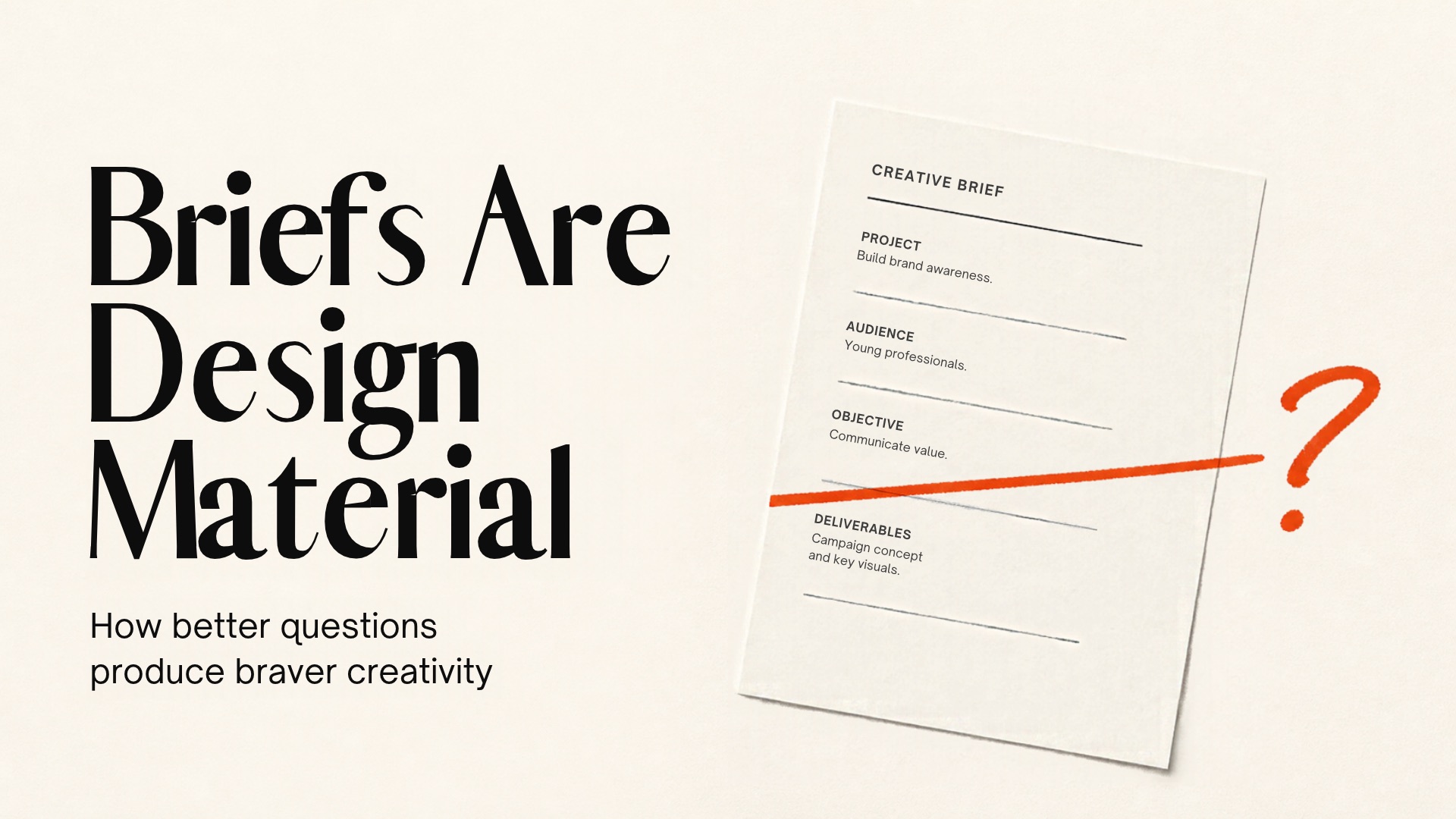
A creative opening a brief has already inherited decisions about the work. The page was written before the concept existed, with less attention than the concept may receive. Its choices will still determine how much there is to develop.
The administrative entries are useful: audience, deliverables, date. A person can organise a project around them. They cannot necessarily make an interesting advertisement from them. Somewhere on the page there needs to be a position, or an unresolved thing worth responding to, as well as instructions for getting the files delivered.
The brief supplies material, and the quality of that material reaches into the work commissioned from it.
A weak brief can fill every box. The objective says awareness among young professionals. The audience description offers ambition, digital fluency and authenticity. The proposition sounds available to any competitor, while the mandatories outgrow the insight. None of the entries must be false for the page to give a creative team very little to work with.
Describing the situation has taken the place of finding what is interesting in it. A team can execute every requirement and still must search outside the brief for its idea.
Take a challenger bank briefing an agency. The safe version reads: build awareness of the app among young professionals; proposition, simple, smart banking; tone, confident and human. Every line is defensible. None of it gives anyone a reason to start.
Now rewrite it around a belief. Young professionals think changing banks costs a weekend and a stack of forms, so they stay with a bank they dislike. The work should show that the cost is mostly imagined, and the client accepts that this tells loyal customers their patience was wasted. Someone will object to that. The objection is already on the page, so the team can write toward it instead of meeting it for the first time at the presentation.
The second version is longer by a few sentences. It hands over a belief to disturb, a person who may push back and a price the client agreed to pay. A creative team can start from any of the three.
Sometimes the client settles on every format and still hesitates when the conversation reaches the proposition. There is the unfinished decision. Stay there for a little longer: the concept will inherit whatever the briefing conversation chooses to leave unresolved.
Which belief about the category does this brand want to disturb? There needs to be a reason for choosing it, because the creative work will have to make that case to an audience.
A particular audience may object to the position. Discuss that audience and objection now. The demand that nobody should dislike the work can leave the team with scarcely a position to develop.
Take the uncertain assumption through to its commercial consequence. If it fails, what happens to the project? Briefing still offers time to look for evidence or make a different choice.
A brand’s prohibition has a history. Discovering its origins may reveal a principle worth honouring, or a decision made long ago under conditions that no longer apply.
Brief from several positions, as Cubism examined a subject from more than one view. Marketing has one account of the problem. Finance has an intended commercial result; customers have their experience of the category. The surrounding culture and the medium’s craft add other possibilities. Bring those accounts together before declaring the problem settled.
Finance may want attributable sales while customers are tired of the same category promises. Something in the culture may explain that fatigue before it appears in the usual research language. Holding those views together gives the team useful edges to work with. A purely departmental account can smooth them away before the creative conversation starts.
Chosen restraint has weight in the Andalucian tradition. Apply that care to the page. Each mandatory needs a reason to occupy it; the proposition needs precision. A cultural observation should be one the eventual work can support. What remains is material for a creative response, with less background competing for attention.
The page can argue from the audience’s present belief to the change the work seeks. It needs a tension to address and evidence the business can supply. Record the client’s acceptance of the risk, with a boundary for exploration. The creative can develop the work from a premise the client has already agreed.
Background that contributes nothing to that argument can come out. The team shouldn’t have to infer which of several pages matters.
Let a creative argue with the page before calling it finished. What would they challenge? Which evidence would change their mind? A discussion that goes straight to formats and dates may be a sign that the brief still has too little to say.
Three checks help before the page goes out. First, put a competitor’s name on the proposition. If it still reads as true, it describes the category and has not chosen anything. Second, ask the strategist to state the tension in one sentence without looking at the page. If that takes a paragraph, the brief holds more than one problem, and the team will pick whichever it likes best, which may not be the one the client needs solved. Third, read the mandatories aloud and ask which the audience would notice if it vanished. The ones nobody would miss are candidates for cutting, or at least for the appendix.
Before an agency attempts brave work, the client has had a chance to make brave decisions in writing. The brief records which awkward questions were answered, and which were deferred. A deferred question is likely to return with the concepts, where answering it can undo work already made.
Give deferred questions a place on the page. A short list at the foot of the brief, headed “not yet decided,” with a name and a date beside each item, is enough. It admits the gap openly and sets a deadline for closing it before concepts arrive. A gap with an owner gets closed. A gap nobody has named is often filled by whoever reacts first in the review, and that is usually the person with the strongest opinion, not the most authority. Over a few projects, the list also shows which kinds of decisions a client avoids, which is useful to know before the next brief.
The choices need people who can commit on both sides. Their seniority is useful before the concepts, when they can settle the uncomfortable part and record the agreement in the brief.
The audience will encounter the consequences of these decisions later. What it has a reason to notice has already been partly determined on the briefing page.
A decision left out of the brief returns with work attached. The concept review may then become an expensive way of discovering the client’s position. An agreed tension gives the discussion a reference point before another round is commissioned.
Confirmation belongs while the position and risk are still on the briefing page. Later, finished concepts make the same conversation harder, because a change must account for work already done.


